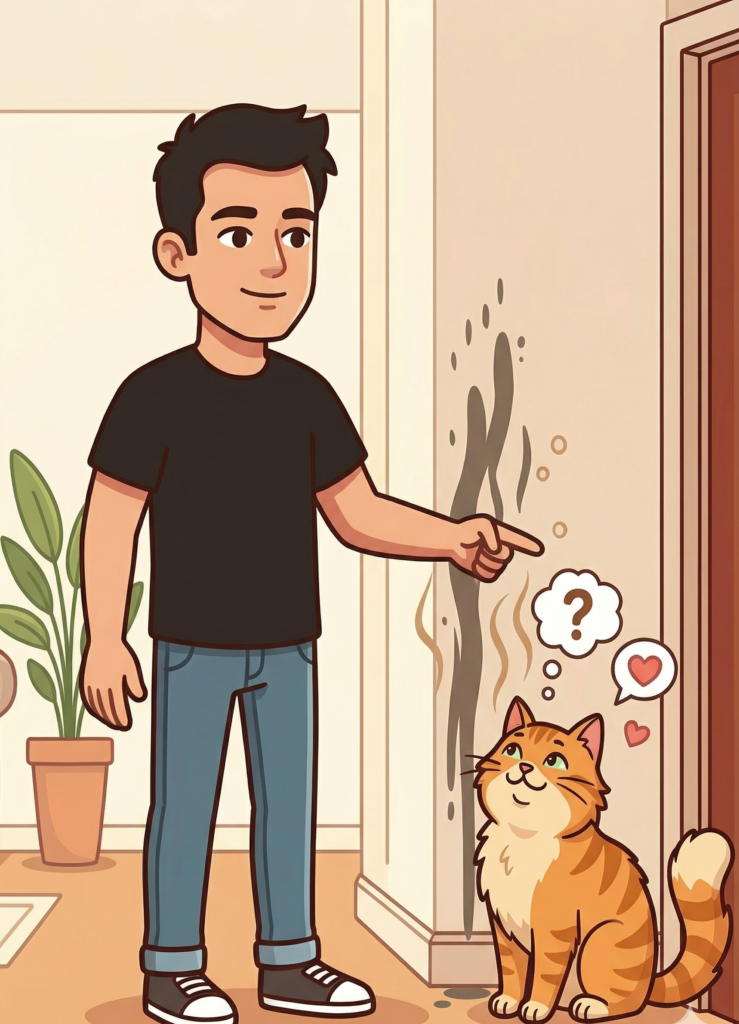
I came home one evening to find a dark, wet streak running down my living room wall, right next to the front door. The smell was something I can only describe as aggressively biological. My cat was sitting nearby, looking perfectly composed. He had left me a message, and he clearly felt good about it.
If you are currently asking why do cats spray inside the house, the first thing to know is that this is not a bathroom accident and it is not spite. Cat spraying is communication. Your cat is telling you something, and the smell is just the volume turned all the way up. In this guide, you will learn exactly why this happens, how to tell it apart from regular peeing, and what actually works to stop the cycle for good.
Is Your Cat’s Health the Root Cause?
Before we dive into the psychology of marking, we have to look at the biology. Pain during urination is a common trigger for marking behaviors. To see if your cat’s activity and intake are balanced, check our Advanced Cat Nutrition Calculator.
Table of Contents
Why Do Cats Spray Inside the House? The Real Answer
catbehaviorhq.com
- 01 Is Your Cat’s Health the Root Cause? →
- 02 Spraying vs. Regular Peeing: The Difference →
- 03 Reason 1: Territorial Friction →
- 04 Reason 2: Hormones and the Call →
- 05 Reason 3: The Scent Wall of Safety →
- 06 Reason 4: Medical Red Flags →
- 07 Reason 5: Environmental Boredom →
- 08 How to Stop the Cycle: A Real Plan →
- 09 Final Thoughts →
Why Do Cats Spray vs. Regular Peeing?
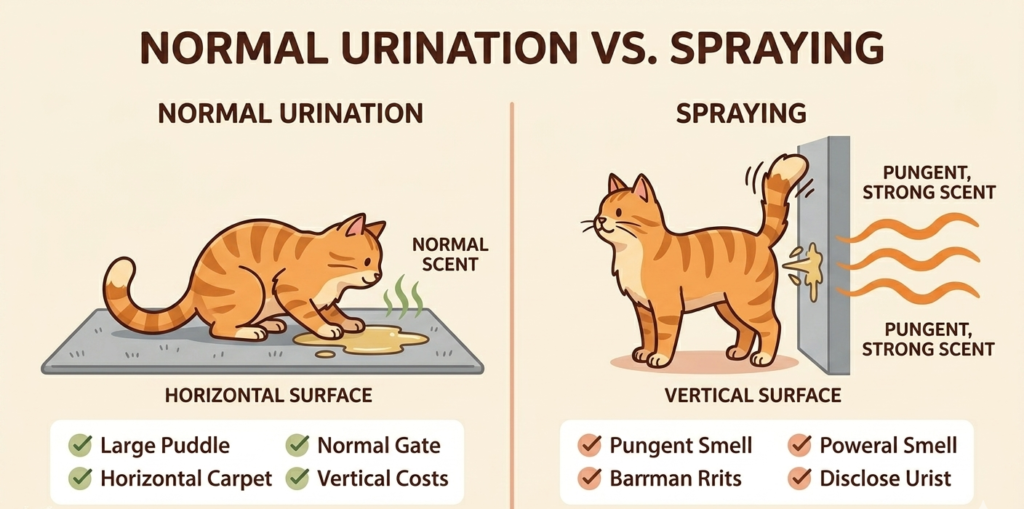
It is vital to understand that spraying and peeing are two completely different things in the feline brain.
When a cat sprays, they stand upright, back up to a vertical surface like a wall or furniture leg, and release a small amount of urine while their tail quivers. This is a behavioral post-it note. Regular peeing, however, is a physical need usually done in a squatting position on a horizontal surface.
| Feature | Regular Peeing | Spraying |
|---|---|---|
| Posture | Squatting low to the ground | Standing tall and upright |
| Surface | Horizontal (floor, carpet) | Vertical (walls, furniture) |
| Volume | Large puddle | Small spritz or streak |
| Scent | Normal urine smell | Pungent, musky, and strong |
Export to Sheets
If you see your cat squatting on the floor instead of backing up to a wall, you are dealing with a different issue. You should check out our guide on cat peeing beside the litter box for those specific solutions.
5 Scientific Reasons Why Do Cats Spray
Understanding the why means looking at the environment through your cat’s eyes. Most cats who mark indoors are reacting to a mix of biology and stress.
1. Territorial Friction
Cats are deeply territorial animals. A landmark study published in the Journal of Feline Medicine and Surgery found that the number of cats in a home is the strongest predictor of spraying behavior. Specifically, the risk of at least one cat spraying increases from 25% in two-cat households to 100% in households with ten or more cats. If your cat feels their “ownership” of a room is being challenged, they will spray to reclaim it.
Source: Pryor PA, Hart BL, Cliff KD, et al. Causes of urine spraying and efficacy of medications.
2. Hormones and The Call
If you have an unneutered cat, biology is the likely answer. Unspayed females in heat often use scent to signal their availability to males. If your cat’s marking is accompanied by strange, loud yowling, read our post on cat in heat behavior to see if the two are linked.
3. The Scent Wall of Safety
To a cat, the smell of their own urine is actually a comfort. If they are feeling overwhelmed by a move, a new baby, or a loud neighborhood, they may spray to create a familiar scent barrier. This is common in cats suffering from cat separation anxiety.
4. Medical Red Flags
Why do cats spray when they are sick? Because inflammation in the bladder (cystitis) makes them feel urgent and anxious. If your cat is also crying in the litter box, stop reading and call your vet immediately, as this can be a sign of a life-threatening blockage.
5. Environmental Boredom
A bored cat is a stressed cat. If your cat doesn’t have enough jobs to do, they may focus their energy on territorial patrolling. I always recommend looking into enrichment for house cats to lower their overall cortisol levels.
How to Stop the Cycle: A Real Plan
Step 1: Rule Out Medical Issues
Always see a vet first. No amount of training will fix a cat that has bladder stones or a painful infection.
Step 2: Use Enzymatic Cleaners
Standard household cleaners often contain ammonia, which actually smells like urine to a cat and encourages them to spray again. Use a cleaner specifically designed to break down the aggressive proteins in feline urine.
Step 3: Decode the Stress
Is there a stray cat outside the window? Sometimes why do cats spray comes down to what they see through the glass. Watch for twitchy behavior using our Cat Body Language Mood Decoder to identify the exact trigger.
Step 4: Never Punish
Punishment is the fastest way to make spraying worse. It increases the anxiety that caused the marking in the first place, leading to a loop of stress-spraying.
Final Thoughts
That streak on my living room wall turned out to be stress from a stray cat outside the front door. My cat felt his castle was under threat. Once I blocked his view of the porch and used pheromone diffusers, the house went back to normal.
Why do cats spray? Because something in their world feels unsettled. Find the cause, address it with patience, and you can reclaim your walls.
If you’re noticing other strange habits, like your cat hiding all day, it is a sign that their overall stress bucket is full. Take it one step at a time!
Frequently Asked Questions
The most common questions cat owners ask about why cats spray inside the house, answered clearly and concisely.