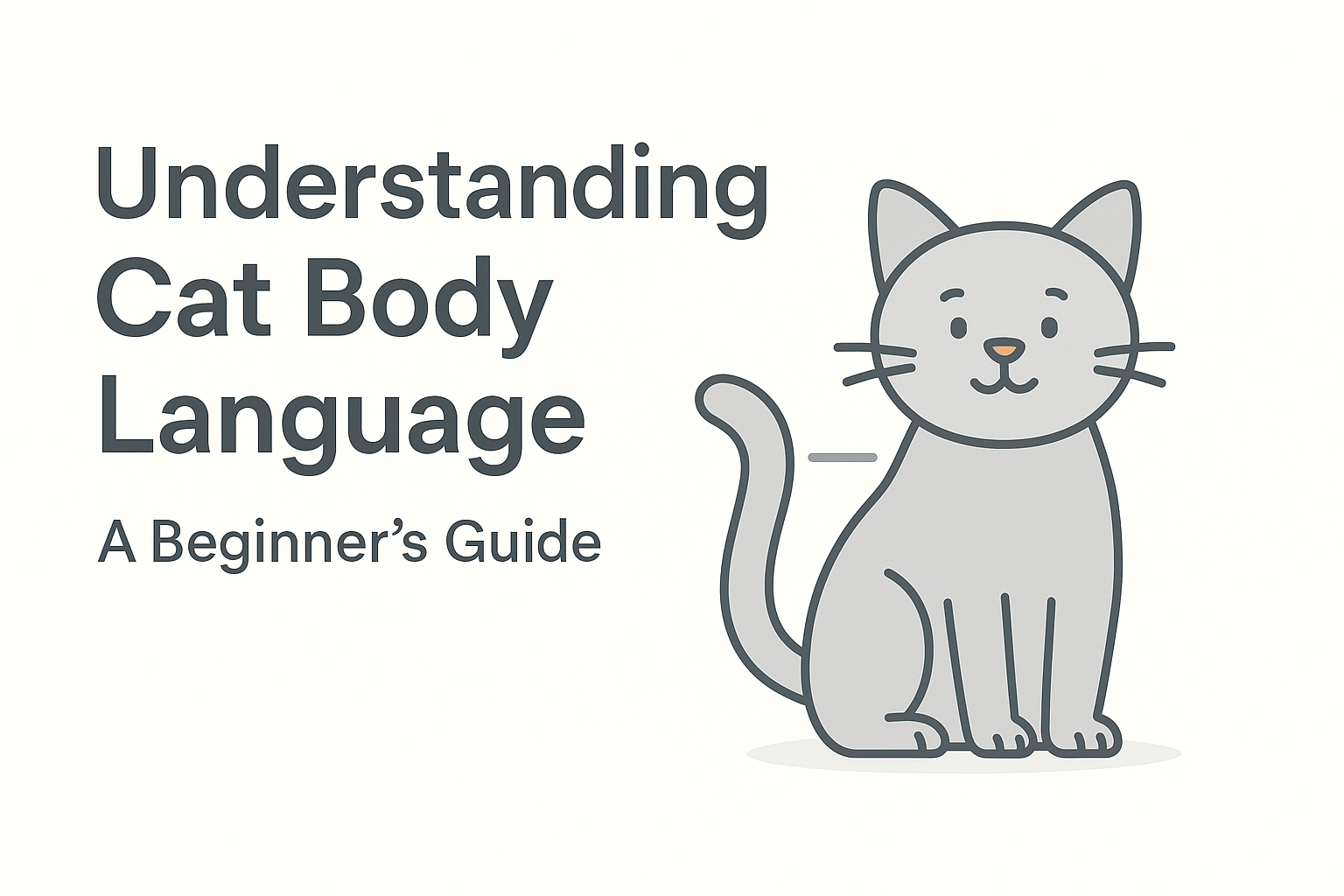
I’ll never forget the day my cat, Oliver, “trapped” me. He was lying on his back, belly exposed, looking like a literal angel. I reached down for a pet, and snap! he turned into a furry bear trap. I thought he was being mean. I was wrong. I just didn’t understand house cat body language.
Most of the big “expert” sites will tell you that a belly show means trust. What they forget to tell you is that for many cats, it’s also a defensive “ready to fight with all four paws” position.
If you want to stop getting scratched and start actually “talking” to your cat, you need to look past the meows. Based on my deep dive into feline ethology and years of living with these tiny tigers, here is how you actually decode what’s happening in your living room.
Is Your Cat Acting Out? Sometimes “bad” behavior is just a cry for a better routine. Before you assume your cat is just being difficult, check our Advanced Cat Nutrition Calculator to see if their diet is fueling their fire.
Table of Contents
The Secret Code: A Deep Dive into House Cat Body Language
catbehaviorhq.com
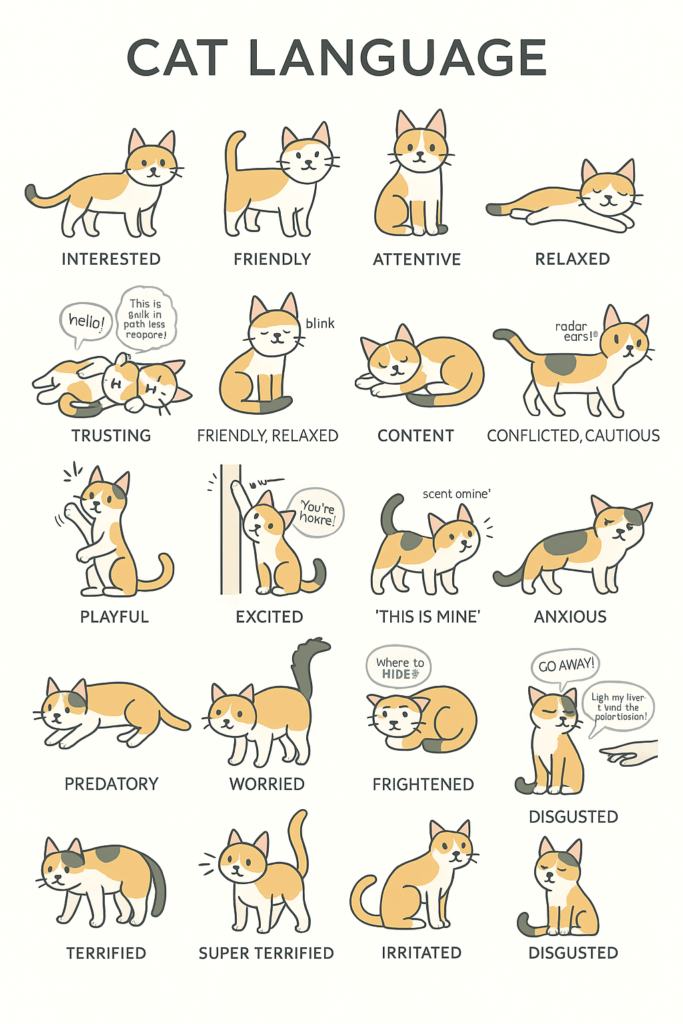
Why House Cat Body Language is Different
You might think a cat is a cat, but our indoor companions communicate differently than feral colonies. A study in Applied Animal Behaviour Science highlights that house cats have adapted their visual cues specifically to communicate with us.
In short: your cat has a specific “house” dialect. If your cat is hiding all day, they aren’t just being shy; they are screaming for space through subtle ear and tail shifts.
How to Read House Cat Body Language
Every cat has their own personality, but the signals they use are surprisingly consistent once you know what to look for. After years of living with cats and getting it wrong more times than I can count, I’ve narrowed it down to five things worth watching: the tail, ears, eyes, posture, and belly. Get those five right and your cat will feel like an open book.
1. The Tail: Your Cat’s Emotional Radar
If you only look at one thing, look at the tail. It is easily the most honest part of the cat. While their faces can be a bit stoic, their tails are broadcasting their internal thoughts in real-time. I’ve learned the hard way that ignoring a thumping tail is the fastest way to get a “love nip.”
The Question Mark (Tail-Up)
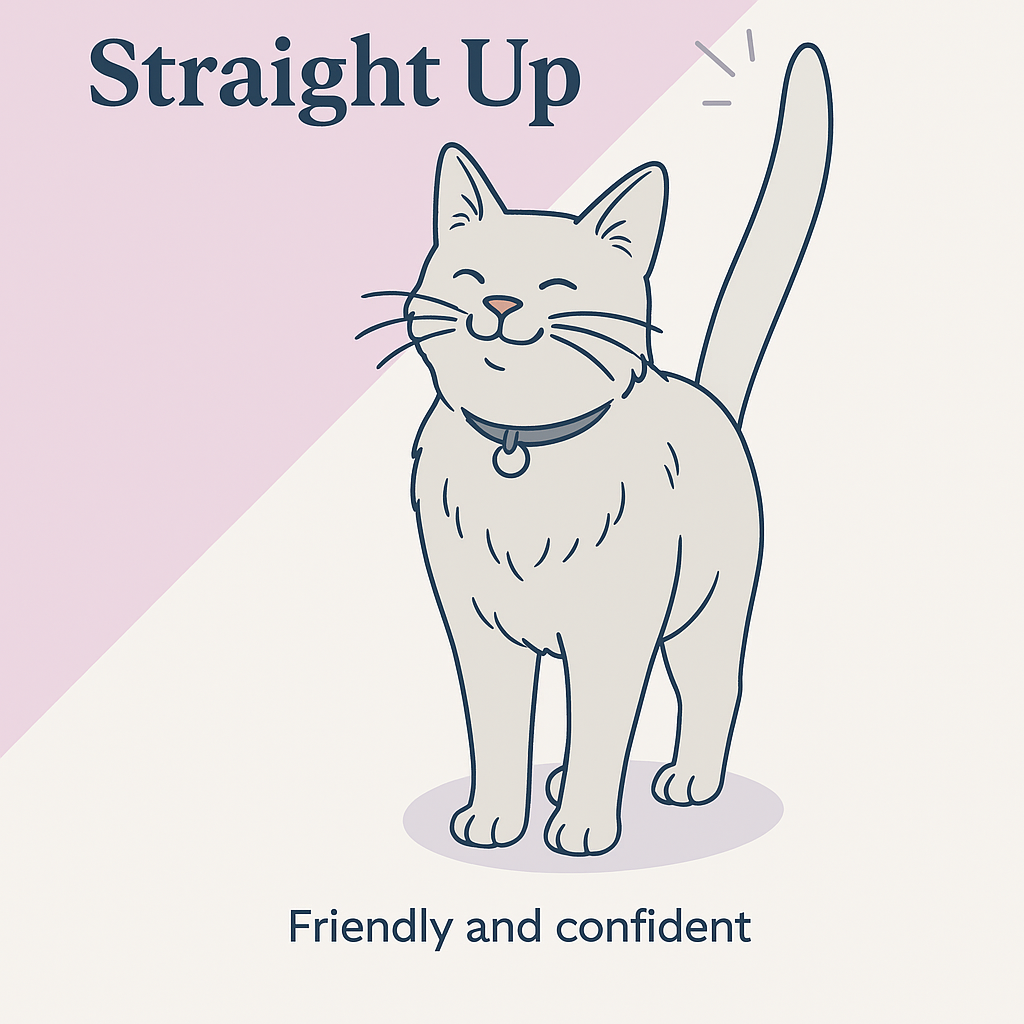
This is what I call the Golden Retriever of house cat body language. When the tail is held high with that little curl at the top, it means they are social, curious, and ready to engage.
The Science: This isn’t just a hunch. A landmark study by Cameron-Beaumont at the University of Southampton, The social function of tail up in the domestic cat, proved that the “tail-up” posture is the ultimate social signal. Researchers showed cats silhouettes of other cats, some with tails up and some with tails down. The cats were significantly more likely to approach the “tail-up” silhouette, proving this posture evolved specifically to say, “I’m a friend, not a threat.” Interestingly, this signal is much more common in domestic cats than their wild ancestors, likely because they needed a clear way to greet us humans without being scary.
The Slow Swish and The Floor Thump
I see a lot of people make the mistake of thinking a wagging cat tail is like a wagging dog tail. It really isn’t. In cats, this is usually a sign of mental conflict or intense focus.
- The Swish: This slow, rhythmic side to side motion often happens when they are staring at a bird or a toy. They are processing high-arousal information and deciding whether to pounce.
- The Thump: If your cat is lying down and their tail starts thumping the floor, back off. This is a clear sign of overstimulation. In my experience, once the thumping starts, the cat is over the petting session and needs some space.
The Bottle Brush (Piloerection)
A puffed up tail is pure adrenaline. Whether it is fear or a sudden burst of the “zoomies,” your cat is experiencing a massive surge of the nervous system. This is formally known as piloerection.
The Science: This is actually an involuntary reflex. Tiny muscles at the base of the hair follicles—called the arrector pili—contract because of an adrenaline spike, causing the fur to stand straight out. Studies on feline physiology, like those found in PubMed’s research on the arrector pili, show that this is a defensive mechanism intended to make the cat look physically larger to a predator. If your cat does this during play, it usually means they have moved from “having fun” to “hyper alert mode.”
If your cat’s tail is constantly thumping or puffed up, they might be dealing with more than just a bad mood. Check out our guide on Cat Stress & Anxiety to see how you can create a calmer environment for them.
2. Ears and the “Airplane” Warning
House cats use their ears like satellite dishes to process the chaos of a human home. I’ve noticed that if I’m crinkling a bag in the kitchen, my cat’s ears can rotate 180 degrees without him even lifting his head.
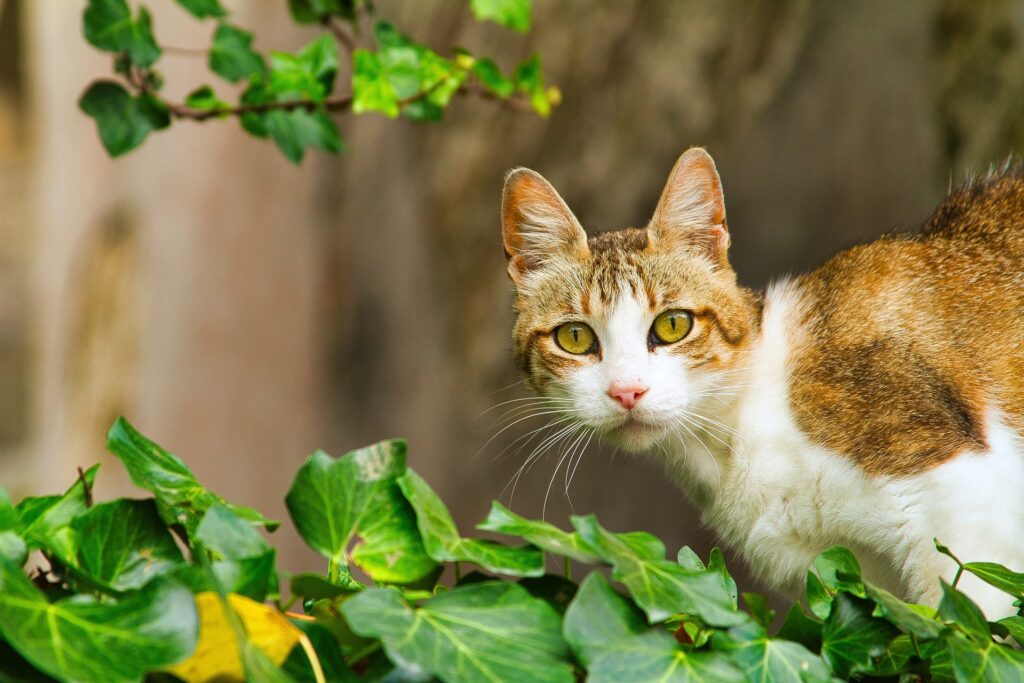
When those ears go flat or sideways what we call “airplane ears”, your cat is feeling vulnerable. They are trying to assess whether the noise in the hallway or the new guest in the room is a threat.
The Science: A 2020 study published in Scientific Reports, Facial expressions of pity and fear in domestic cats, used an objective coding system (CatFACS) to prove that ear positioning is the #1 most reliable indicator of feline stress. The research showed that as a cat’s fear levels rise, their ears rotate backward and flatten against the skull. This isn’t just an “attitude”, it’s a physical protection of their most sensitive sense. If you see these ears often, your cat might be dealing with feline separation anxiety or a disrupted routine.
3. The “Slow Blink” and Eye Communication
We’ve all heard about the slow blink, but I used to think it was just wishful thinking by cat owners. Turns out, it’s a scientifically proven “I love you.”
Decoding the Pupils
- Dilated (Huge): High arousal. This could be play, or it could be terror. Context is everything.
- Constricted (Slits): Focus or agitation. If they are staring at you with slits, they are likely annoyed or stalking your moving toes.
The Science: A 2020 study published in Scientific Reports (Nature), The role of cat eye narrowing movements in cat–human communication, confirmed that “narrowing your eyes” at your cat actually makes them more likely to approach you. The researchers found that cats perceive the slow blink as a sign of safety and relaxation. In their experiments, cats were much more likely to slow-blink back at their owners (and even strangers) if the human initiated the movement first. It’s the feline equivalent of a warm, trusting smile.
Decoding the Pupils
- Dilated (Huge): High arousal. This could be play, or it could be terror. Context is everything.
- Constricted (Slits): Focus or agitation. If they are staring at you with slits, they are likely annoyed or stalking your moving toes.
4. Posture: The “Bear Trap” vs. The Relaxed Roll
This is where most owners get it wrong. A relaxed house cat lies on their side with loose muscles—this is an invitation for a slow blink, not necessarily a belly rub. An arched back, however, is a classic “Halloween cat” fear response. They aren’t being aggressive; they are terrified and trying to look bigger than the “threat” (usually the vacuum).
The Science: A study published in Applied Animal Behaviour Science on feline ethograms confirms that postures like the arched back and piloerection (fur standing up) are primary “distance-increasing” signals. Interestingly, while wild cats use these signals to maintain territory, house cats have adapted them as defensive tools to signal a need for space in cramped human environments. When your cat’s fur stands up, their sympathetic nervous system has triggered an involuntary “freeze or flee” response. It’s their way of saying, “I’m huge and scary, so stay back,” even if they’re actually just a six-pound tabby.
If your cat is constantly tense or overgrooming, their body language is telling you their stress levels are through the roof.
How to Manage Communication Breakdowns
- Wait for the Greeting: Don’t just scoop them up. Wait for the “tail up” or the head-bunt (bunting).
- Provide Enrichment: A bored cat is a stressed cat. High-intensity enrichment for house cats can solve 90% of “bad” behaviors.
- Respect the Hiss: A hiss is a defensive “No thank you.” If you push past a hiss, you’re asking for a scratch or a bite.
Final Thoughts on House Cat Body Language
Learning this “secret code” changed my relationship with my cats. I stopped seeing them as unpredictable and started seeing them as incredibly clear communicators who were just waiting for me to catch up.
Once you master house cat body language, the “random” behaviors start making perfect sense. You’ll catch the warning signs of stress or illness weeks before they become a crisis.
Is your cat currently staring at you with airplane ears? Tell me about your weirdest cat encounters in the comments!
Frequently Asked Questions
Your cat body language questions answered